
Records Behind a Brushy Creek Resident Lookup
No single database confirms that someone lives in Brushy Creek. Start with the question at hand and keep the source’s limits attached to the answer. The appraisal roll can connect a name to a property interest, court indexes can locate a case, and state vital indexes can identify an event. They are useful leads, not interchangeable proof of present occupancy or identity.
| Record | What It Confirms | Where | Access |
|---|---|---|---|
| WCAD property roll | Owner of record, parcel and legal-description lead | Williamson Central Appraisal District | Online search; owner is not necessarily occupant |
| County court index | Case, party, attorney, or calendar lead | Williamson Judicial Records | Online index; clerk holds the official file |
| Voter information | Registration information subject to confidentiality rules | Texas My Voter Portal | Documented identifier routes and statutory limits |
| Marriage or divorce verification | Indexed names, date, and place for a qualifying event | Texas DSHS Vital Statistics | Verification is not a certified license or decree |
| Custody or license record | Agency-specific status or credential lead | Agency’s official locator or license search | Does not establish a Brushy Creek residence |
When an address is already known, check the WCAD record first and separately note its situs and mailing fields. When a case number or attorney name is known, the court index is the more direct lead. When family status is the question, the DSHS verification route is narrower and more reliable than trying to infer an event from a name match.
Define the Person Before You Look Up a Brushy Creek Resident
Write down the full name, middle initial, former or maiden name, suffix, common spelling variants, and the year attached to each source. A shared surname or ZIP is not enough to merge two results. A sound approach requires at least two independent matching details, such as a parcel connection plus a date, a middle name, a party role, or a source-specific identifier.
Brushy Creek can appear under different postal and local labels. Test the exact address and, where relevant, Round Rock, Cedar Park, Leander, Georgetown, or Austin labels alongside a subdivision name. Keep a result log with the name entered, portal, search date, matching key, source date, address-field type, and why the result is a lead rather than confirmation. This makes it possible to revisit an ambiguous record without converting an assumption into a profile.
Confirm an Address While You Look Up a Brushy Creek Resident
WCAD’s basic search accepts a name, address, or property identifier, and its advanced form adds street range, street name, city, ZIP, neighborhood, owner, and legal-description fields. Use the account or QuickRef identifier to return to the same property, then compare the physical situs address with the owner mailing address. The latter may be where tax notices are sent, not a residence.
- Normalize the full name, initials, former names, suffixes, and likely spelling variants, then date every result.
- Start with a known address or parcel identifier in WCAD and preserve the account, physical situs, mailing field, and legal description separately.
- Check the physical address in county GIS or the WCAD parcel map, noting the subdivision, ZIP, and actual jurisdiction.
- Use recorded land records to capture the instrument number, date, document type, grantor, grantee, and legal description.
- Search court records by exact name, then a permitted Soundex or wildcard variant, and retain the party role with the case information.
- Use voter information only as a lawful registration cross-check, then keep protected data out of notes meant for sharing.
- Use DSHS verification or library material to corroborate an event or historical trace, then identify the official custodian for any certified record.
For a recorded relationship, follow the parcel and legal description into the county land-record system. Capture the instrument number, recording date, document type, grantor, grantee, and legal description. A deed documents a recorded interest, not who occupies a home. For a full address-by-address chain rather than a one-person check, the Brushy Creek street directory explains the broader parcel workflow.
If the online property result is unclear, WCAD identifies its office and phone channel, while a written request should name the exact property, year, and data sought. WCAD says a public-information request is for existing records and does not require the district to answer a new question or create a custom data set.
Court Checks When You Look Up a Brushy Creek Resident
The Williamson Judicial Records help page documents Civil, Family & Probate Case Records, and Court Calendar searches. Civil, family, and probate searches can be set to Case, Party, or Attorney. Calendar searches additionally offer Judicial Officer and Defendant Name. Required inputs change with the chosen search, so use the on-screen red plus markers and narrow by court type or date when available.
For name variations, the help page allows Soundex for similar-sounding names or a wildcard for incomplete names and case numbers. Do not combine them. A first or last name wildcard needs at least one character, while a case or cross-reference wildcard needs at least four non-dash characters. Record the party role and case type before treating any result as a match. The official research did not document a live result-column layout, maximum result count, export behavior, or universal image access, so none of those details should be assumed.
For statewide civil, family, or probate discovery, re:SearchTX can be an additional lead, but it does not replace the local clerk. The Williamson District Clerk accepts record requests through its designated form, email, fax, mail, or counter channels when the case belongs there; certified documents are mailed or picked up. County Courts at Law, probate, and other county-filed matters use the County Clerk’s appropriate process. Ask first whether the item is restricted and whether the requested copy is available.
A Court Symbol Is Not a Brushy Creek Resident Result
The court help page says a red W icon signals an active warrant. It is a signal to review the official docket and contact the appropriate clerk, not a full warrant record, a conviction, a current address, or a reason to send money. The help page also describes linked case numbers and a TIF image viewer, but an index hit does not guarantee that a document image is available or unrestricted.
This small interface detail matters because court records are time-sensitive. Save the case number, filing date, party role, event or disposition where displayed, and any restriction notice. For the authoritative file, copy question, or certified record, use the County Clerk or District Clerk for the court type involved. Court files follow judicial-record rules and Rule 12 procedures, not an ordinary Texas Public Information Act request.
Voter and Vital Routes to Look Up a Brushy Creek Resident
Texas My Voter Portal has documented routes of Name plus County plus date of birth, VUID plus date of birth, or Texas driver license or ID plus date of birth. Those identifiers narrow a lawful registration check, but a match is not present-occupancy proof. Election precinct is geographic context only. The county map notes precinct changes effective January 1, 2026, so current mapping should be checked rather than carried forward from an older result.
DSHS indexes marriages from 1966 and divorces from 1968. Its verification letter supplies names, date, and place as indexed, but it is not a certified marriage license or divorce decree. Certified marriage licenses come from the county clerk where issued; certified decrees come from the district clerk where filed. Birth records become public on or after the 75th anniversary of birth, and death records on or after the 25th anniversary of death. Protected vital records require the designated application, identity documentation, and a qualified relationship or tangible direct interest.
DSHS provides an online order route, walk-in service in Austin, mail processing through the VS-142.9 form, and phone guidance for eligibility questions. The form calls for applicant contact details, relationship or reason, event and spouse information, photo ID, signature, and the requested record type. For earlier material, use the County Clerk, Texas State Library and Archives Commission microfilm guidance, or a library collection rather than assuming a statewide online index is complete.
Brushy Creek Resident Lookup Field Inventory
The following is a sample of documented search controls and research notes, not a claim about every result column in a live case record.
- Search subject: case, party, or attorney. The calendar also permits judicial officer and defendant-name searches.
- Name behavior: Soundex or wildcard can assist with variants, subject to the portal’s separate rules.
- Case number: results use linked case numbers; record the number before requesting the file.
- Party role and case type: preserve them because a name can be a plaintiff, defendant, attorney, witness, guardian, executor, or unrelated co-party.
- Image or restriction status: note whether an image opens or the item is restricted. Exact live result columns were not available in the researched help material.
- Docket
- The court’s running record of filings and events in a case.
- Index versus image
- An index points to a record; an image is a viewable copy and may have different access limits.
- Certified copy
- A custodian-issued copy with certification. The District Clerk says certified documents must be mailed or picked up rather than emailed.
Agency Results When You Look Up a Brushy Creek Resident
The Texas license-search page can be a useful credential lead, but a license, business filing, or registered-agent role does not show a home address. The same rule applies to custody sources. Williamson County’s jail route uses first name, last name, or booking number; TDCJ uses name, SID, or TDCJ number; and the federal locator covers Bureau of Prisons records from 1982 forward. Each is an agency-specific record, not a local resident roll.
The official Federal Inmate Locator is shown below. Its name and number routes can help distinguish an agency record from a property or voter result, but any release date or location needs the agency’s own context.
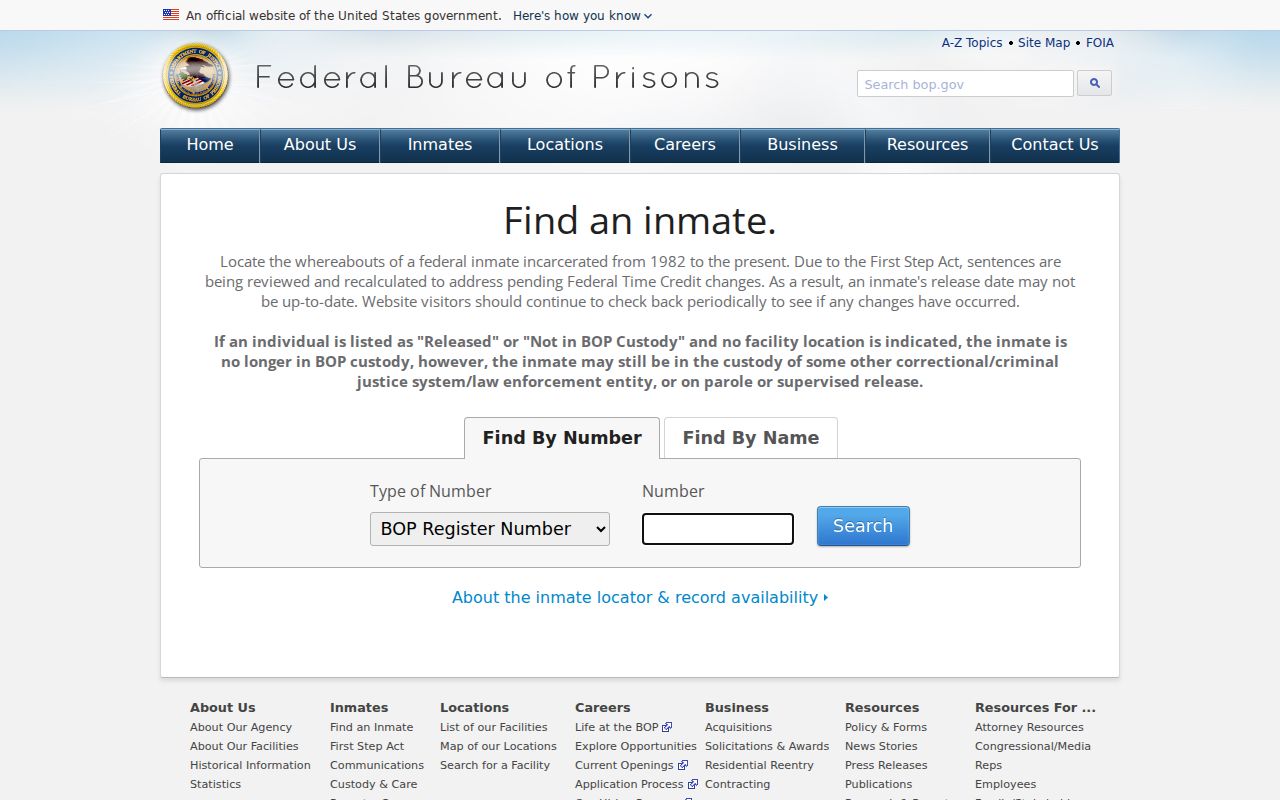
Use a custody result only for the status it states, then verify dates and any court disposition with the appropriate official record. It never resolves a person’s current Brushy Creek address by itself.
Use Official Pages to Look Up a Brushy Creek Resident
The Texas Department of Licensing and Regulation search is another official source shown below. It illustrates why a credential check should remain separate from a residence claim.
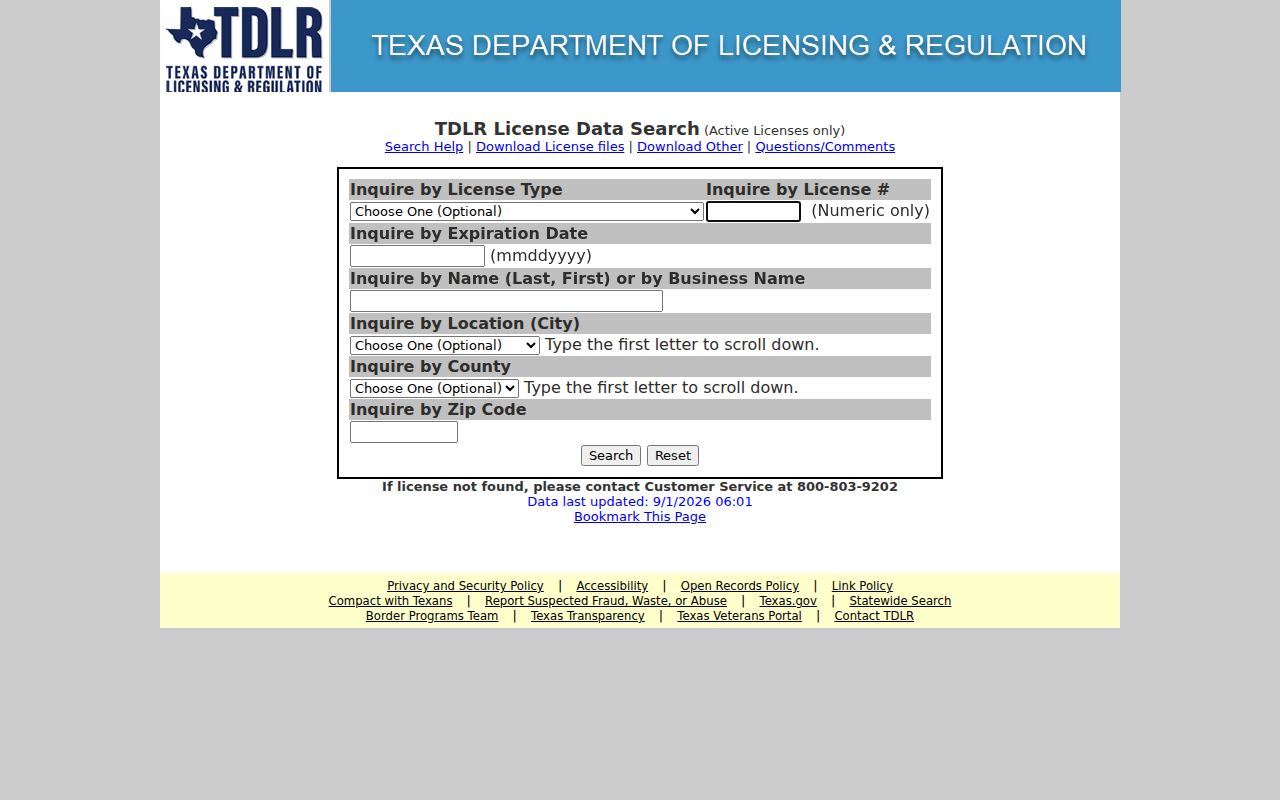
Match an official license or filing only through its own identifier, status, and date. A person can hold a license or appear in a business filing while living elsewhere, so use it as corroboration only when an independent record connects the same individual.
Privacy Limits in a Brushy Creek Resident Lookup
Texas public records do not create a free-form dossier. Courts may restrict juvenile, sealed, expunged, adoption, mental-health, victim, or protected material. Voter records have Election Code confidentiality rules, and the county’s web opt-out removes public display on the county and SOS lookup pages without deleting every public-record route. An Address Confidentiality Program substitute address is a safety measure, not evidence that a person is absent.
For a county-held record, request a specific existing record from its actual custodian, identify the address, parcel, case, date range, or record type, and ask for segregable public portions. The Public Information Act does not make courts or vital records ordinary open-records requests. Corrections belong with the custodian: WCAD requires legal documentation for ownership changes, and a voter-display change uses the county’s opt-out process.
Lawful personal use. Use a Brushy Creek resident lookup for careful personal, family-history, estate, civic, or consumer-safety research. Do not use a record to surveil, threaten, repeatedly contact, intimidate, stalk, harass, or harm another person.